
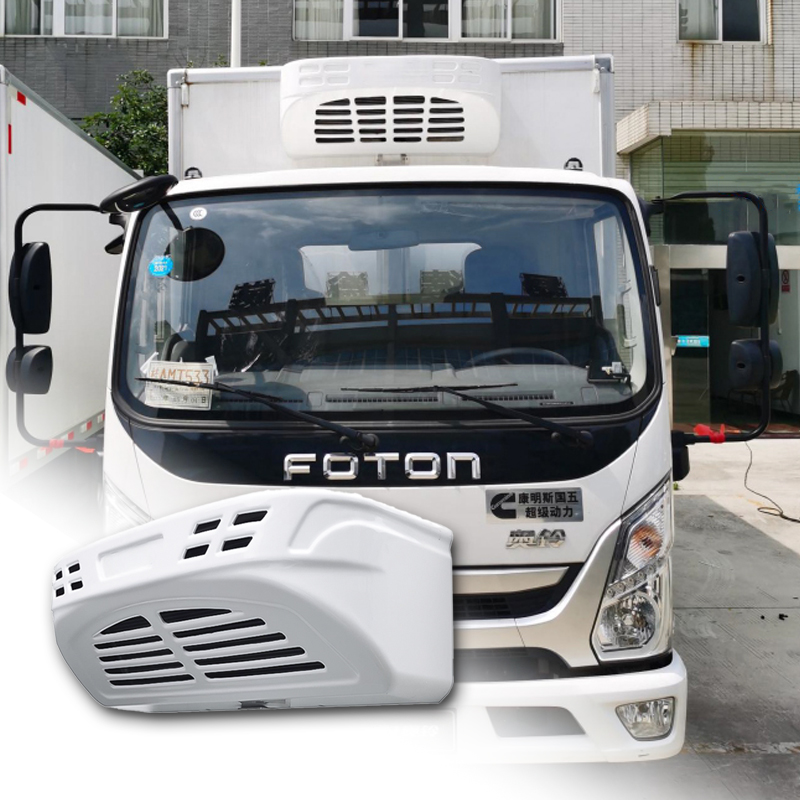
Changzhou Holicen New Energy Technology Co., Ltd. (Holicen) has extended its transport thermal management range. Beyond its existing parking air conditioners, diesel air heaters and automotive air conditioning compressors, the company now supplies refrigerated truck compressors and can provide configurations to suit different vehicle models. Its refrigerated truck air conditioning line — reefer units for the cargo box — is also in production. Both are built for 12V / 24V vehicle electrical systems, and the reefer units carry CE certification. Send us your vehicle model and cooling requirements, and we will confirm whether our current configurations match.
Key Takeaways
- Holicen supplies refrigerated truck compressors and can configure them to a customer's vehicle model.
- At Holicen, "refrigerated truck air conditioning" means the reefer unit that controls cargo box temperature — not the cab air conditioner. These units carry CE certification.
- Both the compressor range and the reefer units are designed for 12V / 24V vehicle electrical systems.
- A match decision takes four inputs: vehicle or unit model, box volume, target box temperature, and vehicle electrical system voltage.
- To confirm a match, contact us at holicen@hlskaac.com.
1. Refrigerated Truck Compressors: Duty Conditions Are Harsher Than in Standard Vehicle Air Conditioning
Compressors in transport refrigeration units run continuously at low evaporating temperatures and high condensing temperatures, so reliability requirements are significantly higher than for a conventional automotive air conditioning compressor.
A refrigerated cargo box must be held within the temperature range its cargo requires, and its evaporating temperature is typically lower than that of a passenger-cabin air conditioner. At the same time, the condenser is usually mounted outside the box, where heat rejection is restricted — and in hot-climate markets, summer condensing pressures climb higher still. The compressor therefore runs for long periods across a wider suction-to-discharge pressure differential, on top of continuous vibration from the road. That combination puts direct stress on bearings, lubrication and seals.
This is why a refrigerated truck compressor cannot simply be a standard automotive air conditioning compressor. Holicen's refrigerated truck compressor range is selected for these duty conditions, and configurations are available to suit different vehicle models.
2. Selection Reference: Compressor Type, Refrigerant and Lubricant
Each target box temperature range corresponds to a fairly consistent combination of compressor type and refrigerant, and the industry has settled into relatively standard configurations.
| Temperature zone | Typical cargo | Common compressor type | Common refrigerants | Lubricant |
| Chilling 0°C to +10°C | Produce, flowers, pharmaceuticals | Scroll / rotary (DC electric) | R134a | POE |
| Chilled -10°C to 0°C | Chilled meat, dairy, short-haul frozen goods | Mostly scroll | R134a / R452A / R448A / R449A | POE |
| Frozen -18°C and below | Frozen meat, ice cream, deep-sea fish | Mostly reciprocating | R404A / R452A | POE |
These are industry-standard configurations given for reference; actual selection depends on system design and the operating envelope approved by the compressor manufacturer. The most common lubricant viscosity grade is ISO VG 68; smaller units may use ISO VG 32.
Compressor type follows the target temperature. Scroll compressors have fewer moving parts, run smoothly with low vibration and noise, and offer high volumetric efficiency — which makes them the mainstream choice for light and medium refrigerated trucks. Reciprocating compressors handle higher compression ratios, are well established and easy to service, and remain the workhorse for deep-freeze duty at -18°C and below. Screw compressors only come into play on larger refrigerated semi-trailers, where cooling capacity requirements are higher.
One caution: scroll compressors tolerate liquid slugging less well than reciprocating compressors. Liquid entering the scroll set strikes the scroll elements directly and damages the bearings, and that damage is irreversible. A scroll-based system therefore has to maintain stable suction superheat and reliable refrigerant feed control. Some small fully electric units do reach -20°C using a larger-displacement scroll compressor — but only when those control conditions are in place.
Refrigerant choice is driven by regulation. R404A has long been the workhorse refrigerant of transport refrigeration, but its global warming potential (GWP) is 3922, and the EU F-Gas Regulation together with the Kigali Amendment continues to squeeze its availability. The industry has broadly adopted R452A, R448A and R449A as transitional options. Of these, R452A is cited by both the European Commission and a UK Climate Change Committee-commissioned report as the preferred replacement for road transport refrigeration, because its discharge temperature is close to that of R404A.
Refrigerant and lubricant must be matched as a set. In transport refrigeration systems, HFC and HFO refrigerants such as R404A, R452A and R134a all require POE (polyol ester) lubricant; mineral oil and alkylbenzene oil cannot be used. Note also that R452A is a zeotropic blend with a temperature glide of roughly 3 K, so it must be charged in the liquid phase, with superheat settings adjusted accordingly.
Power supply and vehicle integration are another easily overlooked step. A 12V / 24V DC system needs its vehicle power budget checked at the selection stage — alternator output and battery capacity on combustion-engine vehicles, or DC supply and remaining traction battery capacity on battery-electric vehicles — so that the refrigeration unit's current draw does not exceed what the vehicle can supply.
3. Refrigerated Truck Air Conditioning: The Reefer Unit Controls Box Temperature Throughout the Journey
At Holicen, refrigerated truck air conditioning refers to the reefer unit that controls cargo box temperature throughout the journey. These units carry CE certification.
This is not the same requirement as a cab comfort air conditioner. A reefer unit has to hold box temperature within the required range through open doors during loading and unloading, high ambient temperatures, and continuous road vibration. Cooling capacity selection depends on box volume, insulation condition, target box temperature and door-opening frequency — which is why the same unit can perform very differently in different boxes.
Telling us your box volume and target box temperature gets you to a match answer faster. The reefer unit and the refrigerated truck compressor can be quoted separately or supplied together as a complete package.
4. How to Confirm Whether Our Configuration Matches
A match decision needs four inputs: vehicle or unit model, box volume, target box temperature, and vehicle electrical system voltage.
Send us that information and Holicen will tell you whether a current configuration matches. If it does not, we will say so and point you toward the available alternatives, so you do not spend time chasing specifications that will not fit.
In one line: refrigerated truck compressor plus reefer unit, configured to your vehicle model, both designed for 12V / 24V vehicle electrical systems, with CE certification on the reefer unit.
FAQ
Does Holicen supply refrigerated truck compressors? Yes. Refrigerated truck compressors are within our product range, built for 12V / 24V vehicle electrical systems, and we can configure them to your vehicle model.
Is Holicen's refrigerated truck air conditioning the same as a cab air conditioner? No. At Holicen, refrigerated truck air conditioning means the reefer unit that controls cargo box temperature throughout the journey. These units carry CE certification.
What refrigerants and lubricants are typically used in refrigerated trucks? The industry standard is to select by temperature zone: R134a is common for chilling duty, while R404A and its lower-GWP replacements R452A, R448A and R449A dominate chilled and frozen duty. In transport refrigeration, all of these are paired with POE (polyol ester) lubricant, most commonly ISO VG 68.
How do I choose between scroll and reciprocating compressors? Scroll compressors run smoothly and offer high volumetric efficiency, making them suitable for light and medium refrigerated trucks and for duty down to about -10°C. Reciprocating compressors handle higher compression ratios and have the advantage below -18°C. Note that scroll compressors are less tolerant of liquid slugging than reciprocating types, so the system must maintain stable suction superheat. The final choice depends on your target box temperature and vehicle conditions.
How do I know whether your configuration matches my vehicle? Send us your vehicle or unit model, box volume, target box temperature and electrical system voltage, and we will give you a match decision.
Which markets do you serve? Hot-climate markets including Latin America, the Middle East, Russia and North America, along with fleet operators and OEM upfitters.
About Holicen — Changzhou Holicen New Energy Technology Ltd.
Changzhou Holicen New Energy Technology Co., Ltd. (brand: Holicen; website: hlskaac.com) manufactures vehicle thermal management products, covering parking air conditioners, diesel air heaters, automotive air conditioning compressors (rotary vane, electric and scroll types) and vehicle refrigerators. The company also supplies refrigerated truck compressors and refrigerated truck air conditioning (reefer units) designed for 12V / 24V vehicle electrical systems.
Store: https://www.alibaba.com/product-detail/Wholesale-24V-Truck-Unit-New-AC_1601588936244.html
Email: holicen@hlskaac.com
Post time: Oct-15-2026